Get Consultation from Experts
First Chat Free
Sign In
Enter your mobile number to continue
By signing in, you agree to our Terms Of Use and Privacy Policy
Download Our App For Better Experience


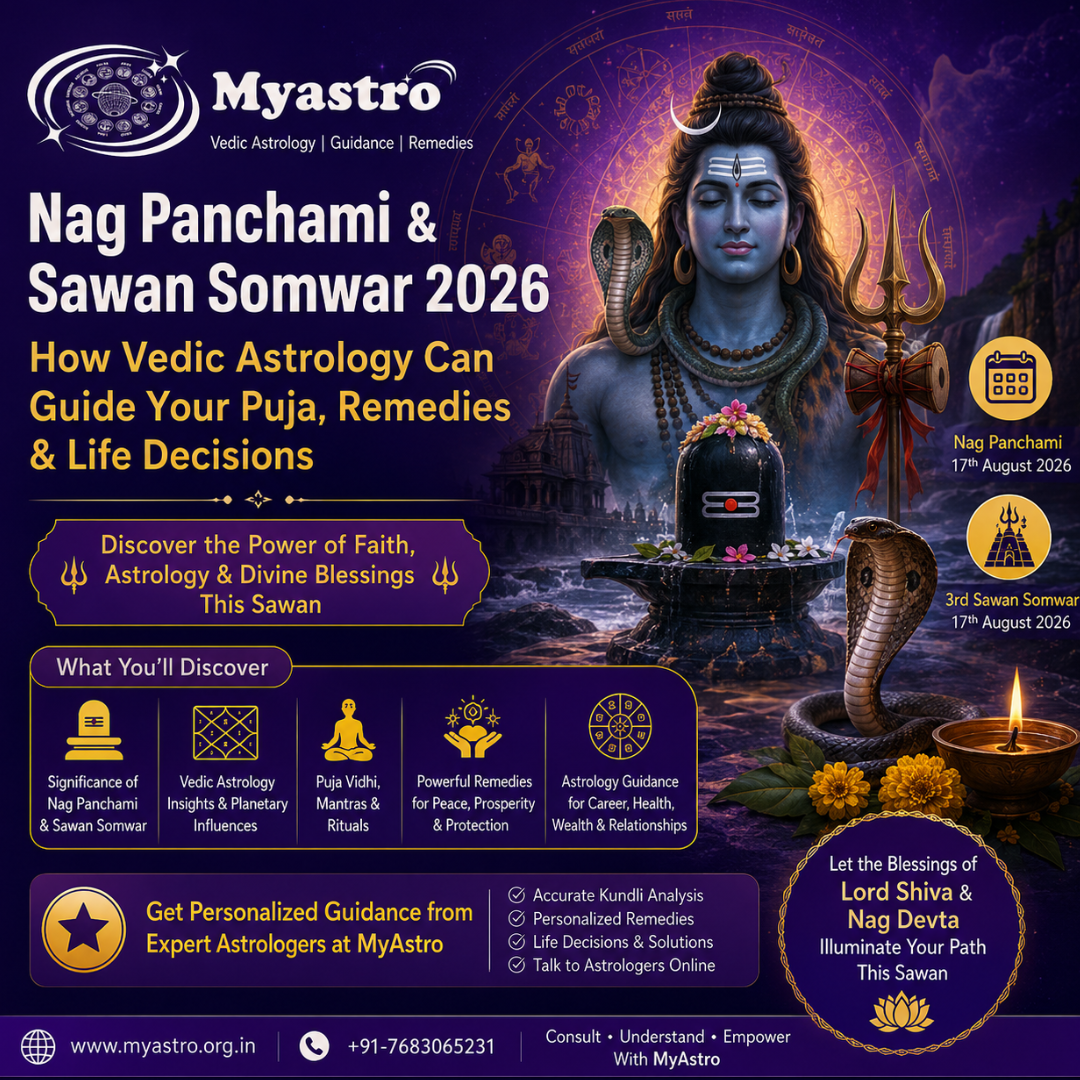
Nag Panchami and Sawan Somwar 2026 create a particularly meaningful spiritual combination for devotees of Lord Shiva and followers of Vedic traditions. In many North Indian regions, Nag Panchami falls on Monday, August 17, 2026, coinciding with the third Sawan Somwar. This convergence brings together serpent worship, Shiva devotion, Shravan observance and traditional astrological symbolism on the same day.
For people interested in Vedic astrology consultation, personalized remedies and spiritual guidance, this occasion offers an opportunity to look beyond routine rituals. The deeper question is not simply what should I do on Nag Panchami? but also: How can traditional worship and my personal birth chart work together to create a more meaningful spiritual practice?
This is where MyAstro brings ancient Vedic wisdom into a modern, accessible format. Through online astrology resources and personalized consultation, MyAstro can help individuals understand their Janam Kundali, planetary influences, zodiac tendencies and appropriate spiritual practices.
Nag Panchami is traditionally observed on Shukla Paksha Panchami during Shravan, while Sawan Somwar refers to Mondays during the sacred Shravan month dedicated to Lord Shiva. In 2026, the North Indian Shravan calendar lists the third Sawan Somwar as August 17, the same day as Nag Panchami.
The combination is significant because both observances have strong connections with Shiva worship.
Lord Shiva is traditionally depicted with a serpent around his neck, making serpent symbolism an important part of Shaiva traditions. Nag Panchami therefore becomes more than a festival associated with snakes; it can also be viewed as a day for devotion, humility, protection, respect for nature and spiritual reflection.
From a Vedic astrology perspective, serpent symbolism is frequently discussed alongside Rahu and Ketu, the lunar nodes. This is one reason terms such as Kaal Sarp Dosha, Sarp Dosha and Rahu-Ketu remedies become especially prominent around Nag Panchami.
Astrology and Hindu ritual traditions often connect specific days with particular planetary energies, deities and spiritual practices.
Nag Panchami is traditionally associated with reverence for serpent deities. In astrology-focused interpretations, this symbolism is often connected with the lunar nodes Rahu and Ketu, which represent themes such as transformation, uncertainty, detachment, desire and karmic lessons.
This does not mean that Nag Panchami is exclusively a “Rahu-Ketu remedy day.” Rather, devotees may use the occasion for prayer, self-discipline and spiritual reflection.
A personalized Vedic astrology consultation can examine:
At MyAstro, this broader perspective can help users understand why a particular remedy may or may not be relevant to their individual horoscope.
Sawan, or Shravan, is traditionally regarded as a sacred month dedicated to Lord Shiva. Mondays falling during Shravan are observed as Sawan Somwar, with many devotees fasting, visiting temples, performing Shiva Puja and chanting Shiva mantras.
For the North Indian calendar followed across regions including Uttar Pradesh, Rajasthan, Madhya Pradesh, Punjab and several other states, the 2026 Sawan Somwar dates are:
Calendar traditions vary by region. For example, the Amanta Shravan calendar followed in Maharashtra, Gujarat, Karnataka, Telangana and some southern regions begins Shravan later, with August 17 listed as the first Shravan Somwar.
Therefore, anyone searching for “Nag Panchami 2026 date,” “Sawan Somwar 2026 dates,” or “Nag Panchami puja muhurat” should check the Panchang for their specific location.
According to the referenced Panchang data, Nag Panchami 2026 is observed on Monday, August 17 in the applicable North Indian calendar. For Shahabad, Karnataka, the listed Nag Panchami Puja Muhurat is 6:06 AM to 8:38 AM, while the Panchami Tithi is shown as beginning on August 16 and ending on August 17. Exact timings can differ by location.
This is particularly important for an online astrology consultant platform because muhurat is location-sensitive.
A time that is auspicious in one city should not automatically be copied for another city.
MyAstro users seeking a personalized approach can consider their local Panchang and, where necessary, consult an astrologer before planning important religious or life activities.
One of the biggest advantages of consulting a Vedic astrology is personalization.
Millions of people may perform Nag Panchami Puja, but every person's birth chart is different.
For example, two individuals may both be experiencing career uncertainty. One might have a challenging Rahu period, while another could be dealing with Saturn-related timing or simply a period requiring patience.
Giving both people exactly the same remedy would ignore their individual charts.
A Vedic astrologer may examine:
1. Rahu
Rahu is traditionally associated with ambition, obsession, unconventional paths, foreign influences and sudden changes.
2. Ketu
Ketu is associated with detachment, spirituality, introspection and unexpected shifts in direction.
3. Saturn
Saturn represents discipline, responsibility, patience and long-term karmic lessons in traditional astrology.
4. Moon
The Moon is important for emotional tendencies, mental patterns and inner stability.
5. Mars
Mars can be considered when interpreting courage, energy, conflict and initiative.
The final interpretation depends on the complete horoscope rather than one planet in isolation.
Kaal Sarp Dosha is one of the most searched astrology concepts around Nag Panchami.
In traditional Jyotish interpretations, it is discussed in relation to the positioning of the seven classical planets between Rahu and Ketu. Different astrologers and schools interpret its importance differently, and not every astrologer considers it equally significant.
This is why people should avoid panic-driven astrology.
If a website tells you that you automatically have a severe dosha simply because you entered your birth date, pause before making major decisions.
A detailed consultation should consider the entire horoscope.
At MyAstro, the emphasis can be placed on understanding the broader birth-chart context rather than encouraging fear.
Traditional astrology considers certain spiritual practices as ways of seeking balance and strengthening positive habits.
Commonly suggested practices around Nag Panchami and Sawan include:
However, these should be understood as traditional spiritual practices, not guaranteed mechanisms for changing planetary positions.
The most important principle is sincerity rather than fear.
Sawan is deeply associated with Lord Shiva in Hindu tradition.
For devotees, Shiva represents transformation, consciousness, detachment and the ability to move beyond destructive patterns.
From a spiritual perspective, Sawan encourages people to slow down.
Modern life often pushes people toward constant activity:
Work. Notifications. Social media. Financial pressure. Relationship anxiety. Career competition.
Sawan creates an opportunity to pause.
A simple Shiva mantra, meditation practice or temple visit can become a structured moment of reflection.
This spiritual dimension is one reason astrology and Sawan rituals continue to appeal to younger generations.
One of the most widely recognised Shiva mantras is:
Om Namah Shivaya
The mantra is traditionally associated with devotion to Lord Shiva.
Rather than treating mantra chanting as a shortcut to guaranteed results, devotees can approach it as a practice of concentration, devotion and mindfulness.
During Sawan, individuals may include mantra chanting in their daily routine according to their own tradition and capacity.
For someone using astrology as a reflective practice, the mantra can become part of a broader routine involving:
Prayer + Meditation + Self-discipline + Positive action + Reflection
That combination can be more meaningful than expecting a single ritual to solve every problem.
People who cannot visit a temple may choose to perform a simple devotional practice at home.
A basic approach can include:
Ritual details vary significantly by region and family tradition.
Importantly, devotees should never handle or feed wild snakes directly as part of a religious ritual. Respect for wildlife and personal safety should come first.
Many people search for Sawan Somwar remedies for career success.
From a Vedic astrology perspective, career interpretation may involve the 10th house, 6th house, 2nd house, 11th house, relevant planets, Dashas and transits.
A traditional spiritual routine could include:
MyAstro can help users explore the astrological side of career questions through personalized birth-chart consultation.
But astrology should complement not replace skills, preparation, networking and professional decision-making.
People also search for Sawan Somwar remedies for wealth and financial growth.
In traditional astrology, financial interpretation may involve the 2nd and 11th houses, Jupiter, Venus, Mercury, the Ascendant and planetary periods.
A spiritual approach could include:
The practical lesson is important:
A remedy should encourage better habits, not replace them.
No ritual can guarantee wealth.
Relationships are another major reason people seek astrology consultations.
Questions often include:
Vedic astrology traditionally examines the 7th house, Venus, Jupiter, Moon, Navamsa and planetary periods when assessing marriage-related themes.
Sawan can provide a spiritual opportunity to reflect on relationships.
Rather than asking only, “Will I get married?”, consider asking:
“What kind of relationship patterns do I need to understand?”
That shift can make an astrology consultation much more useful.
People sometimes search for Sawan remedies for health problems.
Astrology may be used traditionally to explore symbolic tendencies involving health and wellbeing, but it should never replace medical diagnosis or treatment.
If you have symptoms, consult a qualified healthcare professional.
Spiritual practices such as meditation, prayer, adequate rest and mindful routines can support general wellbeing for many people, but they are not substitutes for medical care.
MyAstro's astrology guidance should therefore be viewed as a spiritual and reflective resource rather than medical advice.
It is tempting to create viral headlines claiming that a particular festival will make exactly five zodiac signs rich or guarantee success for specific signs.
Real Vedic astrology is more nuanced.
A person's Sun sign alone cannot determine the complete impact of Nag Panchami or Sawan Somwar.
For example, an astrologer would ideally consider:
Therefore, generalized zodiac predictions should be treated as broad entertainment or reflection rather than personalized forecasts.
This is where MyAstro can become particularly useful.
Instead of searching for a different generic remedy for every problem, users can approach astrology systematically.
Provide your:
These details form the foundation of a personalized Janam Kundli.
Be specific.
Instead of:
“Tell me my future.”
Try:
“What does my chart indicate about career changes over the coming period?”
Or:
“What should I consider before making a major relationship decision?”
A Vedic astrology consultant can explain relevant planetary placements and periods.
If a remedy is suggested, understand its traditional reasoning rather than following it blindly.
Use the consultation as a tool for reflection and planning.
The online astrology industry has expanded rapidly, but convenience should not come at the expense of clarity.
A useful astrology platform should focus on:
Personalized Guidance
Every birth chart is different.
Accessibility
Users should be able to explore astrology without complicated processes.
Traditional Context
Vedic astrology should be explained within its traditional framework.
Practical Communication
Astrological concepts should be understandable rather than unnecessarily complicated.
Responsible Guidance
Predictions should not create unnecessary fear.
MyAstro's vision of online astrology is built around bringing traditional astrology into a digital environment where users can explore their questions more conveniently.
Today's astrology audience is not limited to grandparents or traditional families.
Young professionals search for:
The appeal is simple.
People want traditional wisdom presented in a format that fits modern life.
You can explore astrology from a smartphone instead of waiting for an appointment or carrying handwritten charts from one place to another.
One of the most important principles for modern astrology is responsible communication.
If someone hears:
“You have Kaal Sarp Dosha, so something terrible will happen.”
that can create unnecessary anxiety.
A better approach is:
“Your chart contains a configuration that some Jyotish traditions interpret in this way. Let's understand the complete chart and consider traditional practices if they are appropriate.”
That difference matters.
Astrology should encourage awareness rather than fear.
MyAstro can position personalized astrology as a journey toward self-understanding, reflection and informed decision-making rather than absolute certainty.
Nag Panchami has an important cultural message beyond planetary interpretations.
Serpent worship represents reverence toward nature and living beings.
In a modern world facing environmental challenges, this message remains relevant.
The festival encourages:
When combined with Sawan Somwar, the day becomes an opportunity for devotion and introspection.
For someone interested in combining tradition with personal vedic astrology, a simple framework could be:
Morning
Begin the day calmly.
Take a bath, maintain personal cleanliness and prepare your prayer space.
Puja
Perform Shiva worship according to your family or regional tradition.
Mantra
Chant Om Namah Shivaya with concentration.
Reflection
Spend a few minutes thinking about one habit or decision you want to improve.
Astrology
Review your personalized horoscope or consult an astrologer about a specific life question.
Charity
Offer help to someone within your means.
Evening
End the day with gratitude rather than anxiety about predictions.
This transforms the festival from a checklist into a meaningful spiritual practice.
Practices differ across communities, so local tradition should always be respected.
However, some broad principles are sensible:
The strongest spiritual practice is often devotion combined with responsibility.
The popularity of searches such as “best astrology consultant platform in India,” “Vedic astrology consultant,” “Nag Panchami remedies,” “Sawan Somwar remedies” and “online astrology consultation” shows how traditional practices are being integrated into digital life.
But the future of astrology should not simply be about generating more predictions.
It should be about generating better questions.
Instead of asking:
“Will I become successful?”
Ask:
“What strengths should I develop?”
Instead of:
“Will this relationship work?”
Ask:
“What compatibility patterns should we understand?”
Instead of:
“Will this remedy fix my problem?”
Ask:
“What does my chart traditionally indicate, and what practical actions can I take?”
This is the kind of approach that makes astrology more meaningful.
Nag Panchami and Sawan Somwar 2026 offer a powerful reminder that spirituality does not have to disappear in the digital age.
A person can check a Panchang on a smartphone, generate a Janam Kundli online, learn about Rahu and Ketu, explore traditional Shiva practices and connect with an astrologer all while maintaining respect for the traditions behind them.
That is the opportunity for platforms such as MyAstro.
MyAstro can serve as a bridge between ancient Vedic astrology and modern users, helping people explore their birth charts, understand traditional astrological concepts and seek personalized guidance for questions involving career, relationships, marriage, wealth and personal growth.
The real value is not in promising certainty. It is in providing perspective.
Nag Panchami 2026 and the third Sawan Somwar coincide on Monday, August 17, creating a particularly notable day in the North Indian festival calendar.
For devotees, it is an opportunity to honour Nag Devta, worship Lord Shiva and participate in traditional Sawan practices.
For astrology enthusiasts, it can also become an opportunity to understand the symbolism of Rahu, Ketu, planetary periods and individual birth charts.
And for modern seekers, it can be a reminder that spiritual practices work best when combined with awareness, discipline, compassion and responsible action.
With MyAstro, the journey can go beyond a generic festival prediction. Your birth chart is personal, your questions are personal and your circumstances are personal.
So this Nag Panchami and Sawan Somwar, don't simply ask what the stars have planned.
Take a moment to understand yourself, reflect on your choices and seek guidance where it can genuinely help.
Answer: Nag Panchami is observed on Monday, August 17, 2026 in the North Indian calendar referenced here. The day also coincides with the third Sawan Somwar in that calendar.
Answer: The two observances coincide on August 17 in the North Indian calendar, combining Nag Devta worship with a Monday traditionally dedicated to Lord Shiva.
Answer: Nag Panchami is traditionally associated with serpent worship. In astrology-oriented interpretations, its symbolism is often discussed in connection with Rahu and Ketu and themes of karmic transformation.
Answer: It is traditionally considered an important occasion for spiritual practices associated with serpent worship and, in some astrological traditions, Rahu-Ketu remedies. A personalized Kundali analysis is preferable before choosing a specific remedy.
Answer: Om Namah Shivaya is one of the most widely recognised Shiva mantras and is commonly chanted during Sawan.
Answer: Yes. Devotees can follow their family and regional traditions for home worship. The emphasis should be on respectful prayer and safe practices.
Answer: Astrology can provide a traditional interpretive framework, but no festival or astrological reading can guarantee a specific future event.
Answer: Not necessarily. Whether a particular configuration is important depends on the complete horoscope and the interpretive tradition being followed.
Answer: MyAstro can be used to explore personalized astrology guidance, including questions involving Janam Kundli, career, relationships, marriage, numerology and planetary influences.
Answer: No. Traditional remedies should be understood as spiritual practices rather than guaranteed mechanisms for changing planetary outcomes.
Answer: For the North Indian Shravan calendar, Nag Panchami falls on the third Sawan Somwar, August 17, 2026.
Answer: No. Shravan observance follows different regional calendar systems. For example, some western and southern regions begin Shravan later than North India, changing the numbering of Sawan Mondays.